
Carroll Finds Success, Stablility in New Role
Updated: January 6, 2018 at 9:33 pm
By Bill Finley
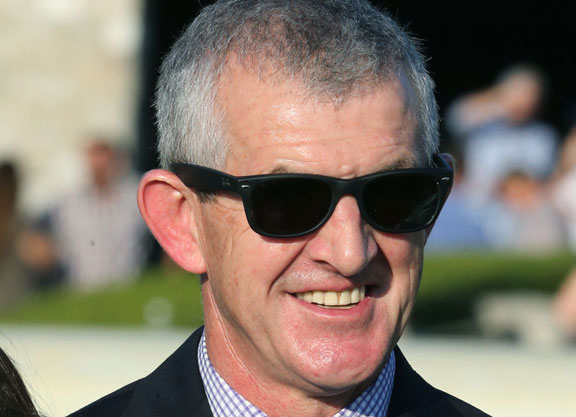
His father, his brother and his nephew all turned out to be top riders, but David Carroll just wasn't blessed with the jockey gene. From County Meath in Ireland, he went into the family business and tried to make it as in the saddle. But there was a problem–a lack of talent.
“I was probably one of the worst jockeys in the history of riding,” Carroll said. “When you are the son of a very successful rider and the brother of a very successful jockey there are a lot of expectations. With me, the apple fell very far from the tree.”
Carroll's failure to succeed as a jockey in his native country led him in 1984 to come to America in search of opportunities in the U.S. racing business. Like most in racing, his career has been marked by peaks and valleys, but he has settled into a new position as an assistant to top trainer Mark Casse and says, “this move turned out to be one of the best things that's ever happened to me.”
Had Carroll been a better jockey, he probably never would have left Ireland, but he said he grew disillusioned by the lack of opportunities there. Unsure what direction to take within racing, he enrolled in a course at the Irish National Stud, which sent its students to a similar program run by Taylor Made in Lexington, Kentucky. It was while he was with Taylor Made that he decided America was the place for him.
“That was a great experience,” he said. “I got to go racing and see American racing at its best at Keeneland and Saratoga. Racing was always in my blood and I really liked what I saw.”
He still could have gone home and tried to reinvent himself in Ireland, perhaps as a steeplechase jockey. His father, Frankie, was a top jump rider whose big-race wins included the Thyestes Chase on Blue Moth in 1960 and on Hunter's Breeze in 1961 and the 1966 Galway Hurdle on Warkey. Or he could have given riding on the flat another chance, hoping that maybe things would click and he'd enjoy some of the success his brother Raymond had. Raymond's biggest victory was in the 1980 G1 Irish St Leger on the Vincent O'Brien-trained Gonzales. Raymond's son, Gary, was a champion apprentice rider in Ireland in both 2009 and 2010.
But Carroll was sold on America and took a job with trainer Shug McGaughey as an exercise rider. He was the regular trackword rider for 1989 GI Belmont S. winner Easy Goer, who also finished second to Sunday Silence in both the GI Kentucky Derby and GI Preakness S.
“Once I finished my course with Taylor Made and got the opportunity to work for Shug, all I really wanted to do was train,” he said. “I got be around horses like Personal Ensign, Seeking the Gold, Easy Goer. The only thing in my mind was to be a trainer.”
Carroll left McGaughey and went out on his own in 1992. He never had a particularly big stable but established a reputation as an excellent horseman and one who knew how to manage a good horse. He won 17 graded stakes races, including the 2010 GI Spinster with Acoma (Empire Maker). But as time went on, he saw the numbers in his barn start to dwindle and no longer was he getting the type of quality horses he wanted to train.
“Having to give something up I did for so long was one of the hardest things I've ever had to do,” he said. “It was very stressful financially. My son just graduated from the University of Kentucky and my daughter is a senior in high school. The expenses just kept adding up and the caliber of the horses I was getting was going the other way. I couldn't really understand why. The harder I worked the fewer horses I got. The bigger stables kept getting bigger. And it just got to be a point where financially it was too stressful for me and my wife. I didn't want to wake up one morning knowing I had a handful of maiden claimers with everybody telling me how good a horsemen I was, but those same people not giving me any horses.”
In March, 2016 he left to work for Casse. It was a lot better than just your average assistant trainer's job. Casse runs and wins all over North America and has one of the top stables in the country.
“For me, it's not just the job itself,” Carroll said. “Mark is the most unbelievable person you could ever be around. I have so much respect for him as a person. He is a great horse trainer, but I have even more respect for him as a person, as a human being. That makes my job so much better because you are working for the type of person where every day you wake up and say how can I do a better job than I did yesterday? That's a great way to go about your job, to go about life.”
Carroll is in charge of the day-to-day training of Casse's division that rotates between the Fair Grounds in New Orleans and the Kentucky racetracks.
From the time he came to the U.S., he has never looked back or regretted the move. But when asked if he would advise young horsemen in Ireland to do today what he did over 30 years ago, he said he would hesitate to tell them to make the move. When Carroll came to the U.S. most top trainers typically had no more than 30 or 40 horses in their barns. That was before the advent of the super trainers, people like Chad Brown, Todd Pletcher and Bob Baffert. They may have over 200 horses under their care and they win with a high percentage of their starters. Owners flock to them.
Carroll believes that's the primary reason his training business suffered, that mid-level trainers in the U.S. have a very difficult time attracting owners because they all want to go with the superstars of the sport.
“There is an opportunity for Europeans to become trainers in America, but not to the extent that there was when I came here,” he said. “Now, if you start off with 10 horses some people can actually make it. But you see a lot of trainers starting off and they're out of business before you know it. Financially, it can be such a stress. Bigger owners are going to the bigger trainers and very few people want to give young trainers an opportunity.
“It's harder than ever and this can be a brutal business. But having said that, I love this game with all my heart and I love the thrill of winning. I always will.”