
Plenty on Offer for Euros in Sydney
Updated: January 25, 2016 at 7:29 pm
By John Berry
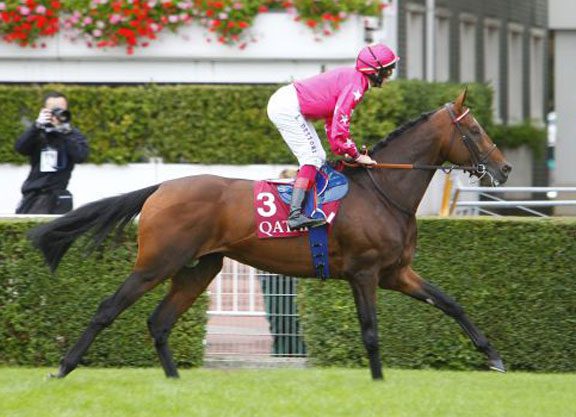
Newmarket is known as 'HQ' for the obvious reason that it is pretty much Britain's centre of everything: training, racing, breeding, etc. One of its lesser-known specialities is the provision of quarantine facilities. These come into their own when European horses are set for races in Australia.
Newmarket's quarantine station at Side Hill Stud is not Europe's only facility, but its strength is its access to the top-class training facilities on Newmarket Heath. The latest high-profile racehorse passing through Newmarket's quarantine station is Spiritjim (Fr) (Galileo {Ire}) who ranked as a Group 1 winner for a few weeks in the summer of 2014 before being disqualified for testing positive to clenbuterol after his defeat of Frankel's brother Noble Mission (GB) (Galileo {Ire}) in the G1 Grand Prix de Saint-Cloud. At the time, Spiritjim was trained by Pascal Bary for Hspirit. Now he is owned by Ting Kong Cheng and is set to join the stable of Sydney's champion trainer Chris Waller, who has done so well with European middle-distance and staying imports over the past few years.
Spiritjim ought to have a good chance in races such as the A$2,250,000 G1 BMW at Rosehill (Mar. 26) and the A$4,000,000 G1 Queen Elizabeth S. at Randwick (Apr. 9) during the forthcoming Sydney Autumn Carnival. He will obviously be locally trained by then, but there could be some European-trained contenders at the Carnival as both Gailo Chop (Fr) (Deportivo {GB}) and Highland Reel (Ire) (Galileo {Ire}) are under consideration for what would for each be a second trip Down Under. Both starred during the Melbourne Spring Carnival towards the end of last year, the former winning the G1 Mackinnon S. at Flemington and the later finishing third to Winx (Aus) (Street Cry {Ire}) in the G1 Cox Plate at Moonee Valley.
When the principal race-days of the Sydney Autumn Carnival were rebranded two years ago as 'The Championships' and given a massive injection of cash, there was a push to attract international raiders. Two landmark victories ensued: Gordon Lord Byron (Ire) (Byron {GB}) landing the G1 George Ryder S. at Rosehill for Ireland and Hana's Goal (Jpn) (Orewa Matteruze {Jpn}) taking the G1 Schweppes All Aged S. for Japan.
The Melbourne Spring Carnival has been firmly on the radar of Europeans for a couple of decades. It is surely only a matter of time before Sydney's autumn equivalent becomes a similarly popular goal. In fact, the only surprise is that it is taking so long for European trainers to wake up to the opportunities on offer in Sydney. Rewind nearly 30 years and one might have predicted that Sydney would soon be a regular destination. Surprisingly, this has not yet come to pass.
In the 1980s, the Sydney Turf Club set out to attract international runners. Unsurprisingly, two British trainers grasped the nettle: John Dunlop and Clive Brittain. Each was already famous for his boldness. John Dunlop could boast a string of international victories, including a trio of Group 1 strikes in Italy in 1983 courtesy of Awaasif (Snow Knight {GB}), Jalmood (Blushing Groom {Fr}) and High Hawk (Ire) (Shirley Heights {GB}), victories which rank as three of the first Group 1 triumphs for Sheikh Mohammed. High Hawk, incidentally, has a secure place in the annals: not only was she Sheikh Mohammed's first Royal Ascot winner (when taking the G2 Ribblesdale S. in 1983), but she also produced In The Wings (GB) (Sadler's Wells).
Brittain's CV was even more remarkable. He had landed pioneering big-race victories with Pebbles (GB) (Sharpen Up {GB}) in the 1985 GI Breeders' Cup Turf and Jupiter Island (GB) (St Paddy {GB}) in the 1986 G1 Japan Cup, and had saddled Bold Arrangement (GB) (Persian Bold {Ire}) to finish second in the 1986 GI Kentucky Derby.
In March 1988, the STC put up a million-dollar purse for the G1 Tancred S., thus drawing three runners from Europe. Bart Cummings, who never liked to miss an opportunity to put Europeans in their place, saddled the champion 3-year-old Beau Zam (NZ) (Zamazaan {Fr}) to win by 5 1/2 lengths, but the Dunlop-trained Highland Chieftain (GB) (Kampala {GB}) finished second, with Vaguely Pleasant (Fr) (Fabulous Dancer) third for the French stable of Patrick Biancone. The Robert Collet-trained Le Glorieux (GB) (Cure The Blues) had won the previous year's GI Washington DC International, but finished out of the money in this race.
The traveling clearly did Highland Chieftain no harm, because he ran at Newmarket's Craven Meeting in April and then won the G3 Brigadier Gerard S. at Sandown in May. Later in the summer he scored at both Group 2 and 3 level in Frankfurt.
In 1989 Clive Brittain nearly landed another coup: Top Class (GB) (High Top {GB}) finished second to Cox Plate winner Our Poetic Prince (NZ) (Yeats) in the Tancred. In 1990, when the Tancred had been re-named the BMW International, both Brittain and Dunlop were represented. In a race won by subsequent Caulfield Cup winner Sydeston (Aus) (St Briavels {GB}), Brittain saddled Mountain Kingdom (Exceller) to finish fourth, with good old Highland Chieftain unplaced. The latter had contested New Zealand's short-lived million-dollar race, the DB Classic at Ellerslie, in 1989–as had Brittain's Lapierre (GB) (Lafontaine)–and had followed that by running in Melbourne seven days later, finishing fourth to Vo Rogue (Aus) (Ivor Prince) in the G1 Australian Cup at Flemington.
At this time of year, numerous European horses are heading out to Dubai in search of desert gold. John Dunlop and Clive Brittain are both retired, but both are still around; and both would surely suggest that the big races in Sydney over the next three months ought to be on the radars of enterprising European horsemen.