
James Willoughby: Golden Horn Irish Champion S. Analysis
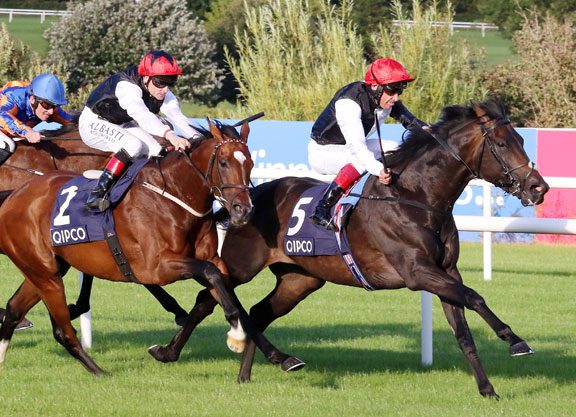
Controversy over the stewards' inquiry that followed the G1 Irish Champion S. took full attention away from future implications of the performance of winner Golden Horn (GB) (Cape Cross {Ire}). By the colt's previous high standards, this was arguably a disappointment.
Okay, so winning at the highest level is hardly a bad result at any time, but we shouldn't just be analyzing racehorses in binary. Back in June, this colt looked like he could rise to the standard reached by the likes of Treve (Fr) (Motivator {GB}) and New Bay (GB) (Dubawi {Ire}) in their Arc trials at Longchamp on Sunday. But the truth is that he hasn't got there, and it is no surprise that bookmakers like Ladbrokes favor not only the French-trained pair, but also Golden Horn's stablemate Jack Hobbs.
Golden Horn increasingly seems to lack an instant punch; it must be doubtful he can match the finishing speed of the French-trained pair above. In Treve's G1 Prix Vermeille, the last two fractions on soft ground were 11.26sec and 12.25sec, while in New Bay's G1 Prix Niel the equivalent numbers werere 11.51sec and 12.21sec. Neither horse was fully extended, and these are world-class numbers considering the conditions.
The previous day at Leopardstown, Golden Horn lacked the same sparkle. He would probably still have held off Free Eagle (Ire) (High Chaparral {Ire}) had he not badly hampered that rival when swerving left inside the final furlong–the move that triggered a stewards' inquiry after which the winner was allowed to keep the race (though strictly against the ethic of fair play, it was the right decision under rules that currently favour the perpetrator of interference rather than the victim).
However, the compacted field behind him generally had less favorable trips throughout the 10-furlong contest, and when international handicappers rate this performance at the end of the season, it won't rate either among the best in Europe, or indeed that of Golden Horn himself.
It is another question why Golden Horn hung so violently. His trainer John Gosden was quick to blame the shadow of the grandstand, but why did this affect only the winner? It speaks of a colt whose mind was wandering as much as his body.
Golden Horn's prospects in the G1 Prix de l'Arc de Triomphe seem to rest on ground and pace; he may improve on a faster surface and for being ridden patiently. The subject of riding tactics is a particularly interesting one here, given Gosden's post-race quotes. “We got our tactics very wrong at York [when Golden Horn won the G1 International S.] and we laid too far back, so I left it to the jockey and he's left it to the other extreme,” the trainer said.
That seems unfair on Frankie Dettori. What was he supposed to do? The 44-year-old arguably won the race with his proactivity early from the rail draw, for another aspect of Golden Horn's performance worthy of particular emphasis is that he was a stride slowly away, and required his rider to hustle him in the early stages to avoid a potentially poor tactical position.
To my mind, Dettori ought to be given extra credit; Gosden's 'I left it to the jockey' is a surprising insight. There was no guaranteed pace in the field of seven and, given that the trainer felt so strongly that tactics brought about Golden Horn's defeat at York, you would have thought it natural for a plan to have been determined. Left to his own devices, Dettori was quick, bold–and, most of all, right to make the running.
This early aggression that was forced on Dettori was bound to take its toll on Golden Horn, but typical of the all-time great in the saddle that he is (Dettori was singled out by legend Lester Piggott in this recent interview), the Italian found a perfect tempo through the middle part of the race on Golden Horn, carving out something like even furlongs of around 12.5sec on the yielding ground. And, when set down for the drive, Golden Horn got down to near 12sec for the penultimate furlong before finishing off in 13.5sec. (These fractions, of course, are hard-timed and thus approximate, in contrast to those provided at Longchamp.)
As a result of Golden Horn's mistakes at the start and end of the race, it seemed like he had a hard race. But inferring the long-term effect this might have is not something that appeals as scientific. Suffice to say, it will be a great training performance from Gosden to get him to peak on Oct. 4 at Longchamp, when it appears as if the form of other key contenders is trending in the positive direction.
In contrast to his stablemate, Jack Hobbs (GB) (Halling) seems likely to produce a personal best at Longchamp. His return in the G3 September S. at Kempton at the beginning of this month was mighty impressive, considering a layoff since winning the G1 Irish Derby in June.