
Another Solid September in the Books
Updated: September 26, 2015 at 10:17 pm
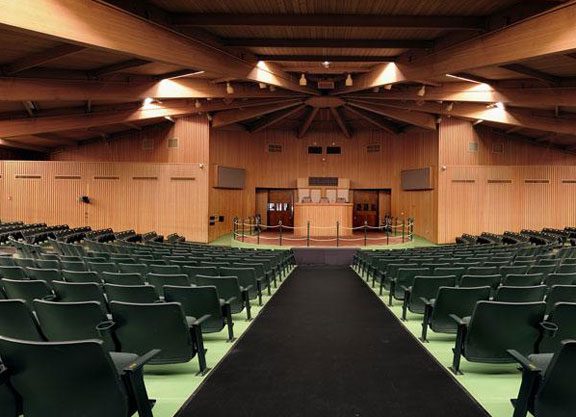
Yearlings by Tapit and War Front were in demand. John Ferguson and Ben Glass struck early and often. And there were improvements in the middle and lower sections of the market. All in all, it was a successful, and yes, mostly predictable, conclusion to the 12-session Keeneland September Sale Saturday in Lexington. But there's nothing wrong with predictability these days, not with visions of turmoil still lingering in the industry's rearview mirror.
“It was as strong, steady two weeks of selling,” said Keeneland Director of Sales Geoffrey Russell. “The momentum generated during Book 1 carried on through the end of the sale, and we surpassed the 2014 gross on Friday's second-to-last session. It was a good sale.”
First, the numbers. From a catalog of 4,164, Keeneland sold 2,745 yearlings for $281,496,100. The resulting average was $102,549, up 3.3% from $99,312. The record-equalling median was $50,000–the same as it was in 2014 and in 2013.
In 2014, from a catalog of 4,181, Keeneland sold 2,819 horses for $279,960,500. The RNA came in at 24.2%. Last year, it was 21.8%.
Topping September was a Gainesway-consigned colt by resident stallion Tapit who sold to Mandy Pope's Whisper Hill Farm for $2.1 million. Pope outbid, among others, trainer Bob Baffert and client Kaleem Shah to secure the Hip 614, a son of Silver Colors (Mr. Greeley).
“He was a super colt, and had all the qualities you look for in a yearling,” said Gainesway's Michael Hernon. “His granddam was the Kentucky Derby-winning filly Winning Colors, and the right people ended up on him. Mandy Pope was determined to buy him. Hopefully, he's a good one. We'd be delighted to have him back as a stallion and stand him for her.”
The colt was among the 11 seven-figure yearlings at September. Last year, there were 13, led by the $2.2 million GSP Air Vice Marshal (War Front).
There was also a new look to the September Sale. Keeneland tweaked last year's format, shortening Book 1 from four days to three, while adding horses to each day. “The new format worked well,” said Russell. “Our goal was to get as many horses in front of buyers as possible. The way we laid it out, the Book 2 buyers were out there when the Book 3 horses were here, and I think that helped the sale along the way.”
One striking aspect of the sale was the remarkable variation of buyers at the top of the market. There were 31 horses who brought $700,000 or more at September. Twenty-five of them were purchased by separate entities, as listed on the sales sheets, though some—such as the $1.5 million Bernardini filly out of Pilfer that Justin Zayat signed for–were bought for partnerships that included other buyers on the list. (Zayat was teaming with the Coolmore partners.)
“I think it's very positive for the market,” said Russell. “It's good to see these horses spread around to numerous people. It shows that people are willing to spend. Pre-2008, the top was dominated by two entities [Coolmore and Darley], and now it's spread around much more, and I think that helps the industry.”
If there was great variation to the buyers who acquired the upper-echelon horses, some observers said there just simply wasn't enough of them to push the market forward at that level. Or, at the very least, the increasing selectivity of those buyers meant signicant soft spots.
“The most interesting thing I saw was the composition and behavior of the buyers and lookers,” said Bluewater Sales's Meg Levy. “The momentum ramped up drastically from Book 1 to Book 2, and the buying bench broadened dramatically.”
Bloodstock agent Ben McElroy agreed.
“I think we all were a bit taken aback by the 30% RNA rate after the first week, but Book 2 and Book 3 picked up, and it was certainly a vibrant market during the second week,” said McElroy.
That vibrancy was evidenced by the fact that, in 10 of the sale's 12 sessions, the highest-priced yearling exceeded the top price of the corresponding session last year.
Both Levy and McElroy said that vet reports played a big factor in getting horses sold.
“We had a very dry July and August, and there seemed to be quite a lot of sesamoiditis when you went to vet them,” said McElroy. “If you're a practical person, that shouldn't really be an issue. But it had an effect, I think.”
There was good foreign participation at the sale, with operations like Japan's Shadai Farm appearing on the docket. But Russell said a bullish U.S. dollar might ultimately have had had a limiting impact.
“There were some buyers who maybe didn't buy as many as they had in the past,” he said. “And I think we were missing some people because of the strength of the dollar. But we don't have much control of that.”
Russell was encouraged by the success that relatively recent entrants into the North American market had as both breeders and buyers. Goncalo Torrealba, whose family purchased a majority interest in Three Chimneys Farm in 2012, bred two of the sale's top four horses, including the $1.65 million Tapit–Pure Clan colt and the $1.5 million Bernardini–Pilfer filly. Mandy Pope's Whisper Hill Farm, meanwhile, bred the $1.45 million War Front–Betterbetterbetter (Ire) filly.
“It's always good to see new investors–especially those who have come in at the higher level–do well in the market,” said Russell. “Goncalo Torrealba, Mandy Pope and Don Alberto all had very good sales. And they haven't just invested heavily in horses. Mr. Torrealba and Don Alberto [the operation that acquired the old Vinery property] have also invested heavily in Central Kentucky, having bought major farms here. That's a positive for the longevity of our business.”
And the Winners Are…
Perennial leader Taylor Made Sales Agency once again topped the consignors list by gross at September, with 256 horses sold for $32,822,200 ($128,212 average). Second on that list was Lane's End, with 179 sold for $25,156,900 ($140,541 average), followed by Gainesway, with 119 sold for $23,489,900 ($197,394 average).
The latter had what Gainesway's Michael Hernon called a “breakout sale,” having sold three of the top four horses. In addition to the $2.1 million Tapit topper, Gainesway sold both of the Three Chimneys-bred horses to make seven figures.
“It was a great group of horses, probably the best we've brought over in recent memory,” said Hernon. “There were no holes across the board, and they were really well received.”
Hernon thanked Torrealba in particular, and related a story about the Three Chimneys chief.
“Mr. Torrealba is friends with [Gainesway owner] Antony [Beck], and was over at the farm a few years ago,” he said. “I got to spend some time with him down at the stallion complex. I happened to ask him back then who would consign some of these horses produced by the good mares he was buying. And he looked me in the eye and said, 'You.' In any case, Three Chimneys afforded us a big opportunity to sell for them, and we're glad their horses sold well. They were top horses, and were very well produced by the farm.”
Darley rep John Ferguson was September's leading buyer, with 24 horses purchased for $8,235,000 ($343,125 average). Crupi's New Castle ranked next, with 24 bought for $7,085,000 ($295,208 average). Gary and Mary West's farm manager Ben Glass was the leading buyer by head, with 26 purchased for $5,550,000 ($213,462), and was the sale's third-leading buyer by gross.
War Front and Tapit once again dominated the stallion rankings. War Front had 21 sell for an average of $600,714; Tapit had 32 sell for $526,875.
The GI Arkansas Derby winner Bodemeister (Empire Maker) led all freshman sires with 48 sold for an average of $178,583. That wasn't a surprise to Ben McElroy.
“I liked the Bodemeisters a lot,” McElroy said. “You could see the Empire Maker in them. They're racy, nice horses, though I don't know how early they'll be.”
McElroy said the same couldn't be said for the surprise third-ranked freshman sire (with more than one sold), The Factor (War Front), who averaged $124,298 off an initial fee of just $15,000.
“You'd probably fancy they'd be early,” said McElroy. “He's by one of the top sires in America, he was lightening quick, and he ran on the dirt. He seems to be getting horses who will go on both turf and dirt, and you'd think they'd be precocious. It will be interesting to see how many wind up in Europe.”
Stormy Atlantic Filly Tops Finale…
A filly by Stormy Atlantic topped Saturday's concluding session at September, eliciting a bid of $65,000 from Sparks View Farm. Consigned by Taylor Made Sales as Hip 4077, the filly was produced by Pleasant Quality (Elusive Quality), herself a half to a good stakes-winning filly by Stormy Atlantic: Saskawea. Saturday's topper is currently named Bluesky Banker Bob.
Sawyer Cattle Company paid $45,000 for the session's top colt, a youngster by Colonel John–Fortress Hill (Forest Wildcat) from the family of Canadian champion Archers Bay. Select Sales, agent for Haymarket Farm, offered the colt was Hip 3964.
In total, 170 horses sold Saturday for $1,518,800. That resulted in an average of $8,934 and a median of $7,000. For complete results, visit www.keeneland.com.