
Global Assembly For IFHA Conference
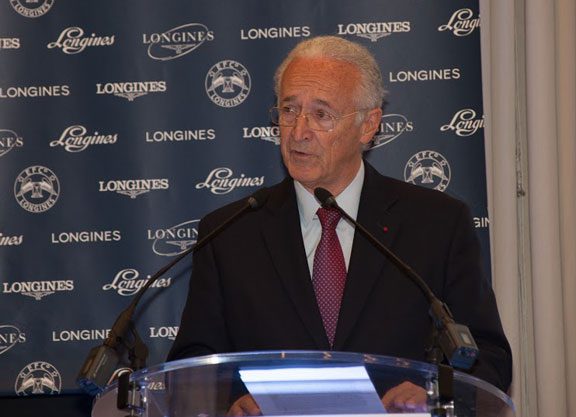
Challenges facing racing media, threats posed by illegal betting markets and an overview of the evolution of the Australian Thoroughbred industry were among the hot topics dissected Monday by delegates from 52 countries at the 49th annual conference of the International Federation of Horseracing Authorities in Paris, France.
The conference was opened by IFHA Chairman Louis Romanet, who presented the organization's strategic plan for the coming years, which includes the certification of labs in each country that meets the criteria set forth by the Task Force of the Advisory Council; promotion of horse and jockey welfare and safety; and the harmonization of basic rules of racing around the world. Romanet also announced the appointment of Andrew Harding as Executive Director of the IFHA, and Andrew Chesser as Secretary General of the Federation.
The three vice chairmen of the IFHA, Winfried Englebrecht-Bresges, Brian Kavanagh and Jim Gagliano also presented key targets to the audience, which included implementing uniforme protest and non-runner rules in Part I countries; uniform artificial track ratings; issues related to the international movement of horses; and race grading and quality control.
Messara Charts Australia's Rise…
The keynote speech was delivered by John Messara, chairman of Racing Australia and chairman and owner of Arrowfield Stud. Messara detailed the evolution of the Australian racing industry over the last 30 years, touching on the revolutions sparked by three key events: breeding stock depreciation provisions (tax breaks for the breeding industry) introduced by the Australian government in 1985; the arrival of Danehill Down Under in 1989; and the establishment of the Commercial Thoroughbred Breeders Association to market the burgeoning Australian product.
“The first thing I was to learn when I launched myself into Thoroughbred racehorse ownership as a 32-year-old stockbroker in 1979 was that change does not come easily to racing and its institutions,” Messara said before presenting figures from 1985, which are staggering compared to today's numbers. In 1985, average prize money in Sydney and Melbourne was A$17,500; 17 Australian-bred yearlings were exported and just 46 mares imported; and the average at the Sydney premier yearling sale was A$22,700, compared to $544,000 at Keeneland the same year.
“We were inward-looking and domestically focused, but for those with an eye to opportunity the immense potential for development was unquestionable,” Messara reminisced.
The first step in this development was the introduction of the breeding stock depreciation provisions by Prime Minister Bob Hawke in 1985.
“It was a single action that in one fell swoop, halted the leakage of the best Australian bloodlines to New Zealand in its tracks and enabled Australian breeders to deploy the necessary capital to acquire breeding stock from the best international pedigrees in Europe and America.”
One of the opportunities permitted by that increased capital was the arrival of Danehill as a shuttle stallion in 1989. Messara noted that a recent study by the Australian Stud Book calculated that 44.6% of horses in training in Australia last season have Danehill in their first three generations, and five of the top 10 Australian sires last seen are his sons or grandson. The success of Danehill during his shuttling years encouraged stallion masters to send 293 Northern Hemisphere-based shuttle sires to Australia during that period, and prompted global operations like Coolmore, Darley, and several others to set up bases Down Under.
Messara then detailed how the Commercial Thoroughbred Breeders Association, formed in 1993, worked to promote the Australian industry internationally, with initiatives including a sale for Australian yearlings in Hong Kong.
“So the tax changes, the arrival of Danehill and a new commercial approach to marketing all played critical roles in the internationalization of Australia's Thoroughbred industry,” he noted.
With Australia's breeding industry coming up to speed with international standards, it was time for the racing sector to follow suit, Messara continued. The government again played a pivotal role, appointing a body known as a Principal Racing Authority in each state to manage that state's industry initiatives and supervise integrity, licensing, advocacy, welfare, marketing and educational functions.
“Freed of these regulatory responsibilities, major race clubs could begin to focus on their own businesses,” Messara said.
Another area where the government affected change for racing–with the PRAs playing a key role–was the New South Wales race fields case, which saw the racing industry win a battle with bookmakers and betting exchanges that required those entities to pay a fee on bets on New South Wales races, and also provide details of betting activity to stewards for integrity purposes.
“Racing NSW won the case and as a result, the racing industry's annual revenue in New South Wales was boosted by more than 30%,” Messara said.
Messara identified the 1993 G1 Melbourne Cup winner Vintage Crop (GB) (Rousillon) as the Danehill of Australia's racing industry, in that he revolutionized it by becoming the first international-trained horse to win the 'race that stops a nation,' taking it one step closer to becoming the race that stops the world.
“The international attention helped drive the expansion of the entire Melbourne Spring Carnival, which now attracts an attendance of more than 325,000 local and international visitors over four days and makes an annual contribution of A$650 million to the economy of the State of Victoria,” Messara said.
One of the more recent initiatives to place Australia alongside the racing giants has been the formation of The Championships, its Sydney autumn carnival held on consecutive Saturdays at Royal Randwick the last two years.
“The traditional Sydney autumn carnival had struggled to match the status of Melbourne's spring carnival as one of the world's major sporting events,” Messara explained. “Our new concept, The Championships, seeks to capture the world's attention through the establishment of a 'destination week' held in Sydney each autumn. We want to create a festival of world-class racing, akin to the Breeders' Cup or Arc weekend, supported by a feast of other social and sporting activities all in the space of one week.”
To wrap up his speech, Messara presented numbers to show how the Australian industry has grown the last 30 years. Average prize money in Sydney and Melbourne has gone from A$17,500 in 1985 to A$110,400 in 2015, a rise more than double the inflation rate. In 1985, no horses traveled to Australia for the spring and autumn carnivals; last year, 53 did. In 1985, Australian horses were not included in racing's official ratings; in 2004, nine were rated above 115, a figure that rose to 40 last year. Last year saw 440 Australian yearlings exported and 200 broodmares imported, and lastly, Sydney's premier yearling sale this year had an average of A$291,000, compared to A$22,700 in 1985–almost five times the inflation rate.
“With so much transformation and reform behind us, the industry that I described as resistant to change in the early 1980s has really flourished and continues to surprise with displays of ingenuity in all sectors of our sport,” Messara said. He concluded with some points of how the country would move forward into the future, highlighting an environment of integrity and drug-free racing; rules of racing that are consistent and represent best practice; enhancement of major carnivals and quarantine facilities; implementation of modern technologies; and addressing society's expectations on matters including animal welfare.
Wealth of Topics in Open Forum…
The open forum section of the conference provided the audience with overviews and updates on a variety of topics, from veterinary topics and issues concerning the international stud book to an introduction to racing in Central Europe.
Dr. Yves Bonnaire of the Advisory Council provided an update on the progress of a task force for combating major doping agents that was devised after last year's conference. Bonnaire noted a list of MDAs with minimum detecting capabilities has been completed, and next steps would include the creation of an IFHA certification laboratories committee before the end of the year.
Andrew Harding discussed issues surrounding international movement of horses, outlining the application of funds supplied by the IFHA “to promote solutions to horse movement impediments.” Those funds will be applied towards research projects specifically surrounding African Horse Sickness and Glanders, and also scientific and technical meetings to advance these causes.
Johnny Weatherby, chairman of the international stud book committee, addressed the assembled audience on future challenges of the ISBC, including finding a balance between adopting scientific reform and maintaining the integrity of the breed.
“For more than two centuries, racehorses have been produced through a form of accelerated selection, but never artificial production,” he noted. “We test the best of each generation in premier races around the world, and as the old maxim goes, then breed the best from the best and hope for the best.”
“However, we do stipulate that there is no artificiality in the Thoroughbred breeding process,” he added. “Thoroughbred production beats to nature's drum, but it is important to remember that in the long run it is not the strongest, or fittest, or fastest that survives–it is the species most adaptable to change.”
He noted that the ISBC is taking a cautious approach to scientific developments to ensure any changes are made in the industry's best interest.
“The Thoroughbred is only about 35 generations into its development. Unproven or unwise decisions on breeding, however well intentioned, could disrupt or destroy in a generation what we and breeders over almost 300 years have developed.”
Weatherby noted a declaration of compliance was released a few days ago that the world's 70 approved stud books must comply with, or have their export privileges removed. “This provides absolute clarity on what is expected of studs books and for the first time, has established certainty on sanctions for non-compliance,” he explained.
Dr. Paul Khann, secretary general of the European & Mediterranean Horseracing Federation, provided a historical look and an update on racing in Central Europe, where racing has taken place in Austria, Czech Republic, Poland, Slovakia and Hungary for more than 200 years. Those five countries banded together in 2009 to create Konferenz von Mittel Europaishe Turf (KMET) to combat challenges in racing facing their nations. Khann noted that KMET is working with German authorities to develop a handicapping system that is compliant with international standards.
An Introduction to Illegal Betting…
The global illegal betting market is likely larger than we realize and threatens racing by undermining integrity and siphoning revenues away from the development of the industry, IFHA Vice Chairman Winfried Engelbrecht-Bresges explained while introducing the “Global and Illegal Betting Market” session of the conference. Engelbrecht-Bresges noted that the legal betting market in Asia is projected to be worth $70 billion next year; the illegal betting market in Asia alone is worth an estimated $500 million per year, and up to $1 trillion. Engelbrecht-Bresges said the internet has caused the illegal betting market to go global.
“They have what people call a customer-centric approach; if you have a gaming need, they fill it,” he said. “They see everybody as a customer and try to bring them into their customer base. The game changer was the internet.”
Engelbrecht-Bresges said many governments fail to acknowledge illegal betting as an issue.
“Government knowledge is pretty limited, because there is not a dedicated effort to understand issues that go outside the boundary of the government. Illegal markets are no longer local–they're not national markets, they're international,” he explained. “Therefore, even facilitating sometimes cross-border cooperation between law enforcement agencies is something we have practiced and would recommend.
He added that much illegal betting is multijurisdictional, involving an illegal operator in one country betting on racing in another country.
Martin Purbrick took over to discuss the scale of the illegal betting market and its links with organized crime. He opened by explaining, “the growth of sports corruption driver by illegal betting operators has had a severe impact on the integrity of sports and the confidence of the public in sports, which is also a threat to racing. The growth of illegal betting in Asia has led to global expansion of the operators, the consequent spread of criminal involvement in racing and other sports betting markets, as well as being a driver for another criminal problems, such as sports corruption and money laundering.”
The largest legal and illegal betting markets are both in Asia, and illegal operations have grown immensely in the last 10 years on the back of the movement to mobile and online gambling. A study released by Sorbonne-ICSS last year estimated that 80% of bets in Asia are illegal. Asia-Pacific operators are expected to be responsible for 70-80% of the illegal betting market. Citibet, the leading–illegal–betting exchange in Asia, is believe to turn over more than the Hong Kong Jockey Club. Purbrick noted that “illegal betting helps criminals fund their activities via fraud, money-laundering and loan-sharking.” He also touched on how easy and cheap it is to set up an illegal betting site. The cost to set up a sports betting website is about €78,000, and €125,000 for a full-suite gambling site.
“That's the other reason we see criminals marching into this area; it's a very cheap investment, it's very easy to do, and no one is stopping them,” he explained. “It's transnational, cross-border, and there's no authority with any influence to prohibit this activity.”
Professor Laurent Vidal, head of the Sorbonne-ICSS research program, took to the microphone after Purbrick to expand on that organization's research on illegal gambling on sports. He noted that “manipulation of sports competitions shows no sign of slowing down; actually, it's getting worse. We have made no improvement in the fight against sports manipulation.” He said there have been between 300 and 700 reported cases of illegal gambling scandals across the world every year since 2010, and the real numbers are expected to be close to 1000.
Vidal pointed out that because larger, organized sporting events are closely controlled, the greatest danger for illegal betting are smaller events.
“When you have a very popular event, it is very scrutinized, so criminals target friendly matches.”
Changing Media Landscape…
The conference concluded with a session entitled “Delivering Media and Information to Bettors and Fans,” and Racing Post Editor and Chief Executive Alan Byrne discussed how having quality independent racing media is essential to maintaining and building a trustworthy racing industry.
“If you sit and listen to group of bettors or fans for any length of time, you will quickly discover they are less trusting of content that is created or provided by bookmakers or even by some racing authorities, and that's why, whatever irritations it may sometimes bring you, a strong, independent racing media delivering reliable content to a range of customer is essential for a thriving industry.”
Byrne noted the landscape of racing media is drastically changing; there has never been more competition for attention in the media, and there have never been more ways to consume media.
“The nature of racing media around the world has changed considerably in recent years. Print sales have fallen dramatically, with digital platforms booming. In many countries, terrestrial or mainstream covering of racing has reduced significantly, and viewing figures are down for those races that are still shown.”
He pointed out that racing now seeks to reach its core customers through dedicated TV channels, which provide an excellent service to the key audience, usually bettors, but they “narrow the reach of the sport,” according to Byrne, “reducing the connection points between racing and its broader customer base.”
Byrne noted that the sale of dedicated racing newspapers in Britain and Ireland has fallen from about 200,000 per year in the 1960s to about 50,000 now. Likewise, viewership of the Epsom Derby on terrestrial TV has more than halved in the last 10 years.
Byrne attributed the changes in media consumption to structural changes in the media industry, including the shift from print to digital preferences; and switches to streaming and online viewing.
“On every front there is increased competition for customers' attention, which poses major challenges for racing and racing media,” he added. “The result is that the audience has become extraordinarily fragmented, and it is more and more difficult for all of us to maintain, nevermind improve, our positions in the marketplace. General media coverage of racing has diminished in most countries, and the sport has struggled to maintain a global audience.”
He continued, “these trends might be expected to advance specialist racing media, but reduced coverage is bad for all of us.”
TabCorp's Paul Cross wrapped up session by giving the audience an overview of how that organization delivers media and information to bettors and fans. Tabcorp–which has 2,850 retail outlets in New South Wales and Victoria and 270 racecourses with wagering facilities as well as broadcasting and streaming 105,000 races per year and exporting product to over 130 countries–has designed its user experience by studying its customers, breaking them down into eight categories. Their studies show calculators–sophisticated regular bettors–account for 6% of their customer base–the lowest–but 21% of turnover–the highest–while big-event followers (those who play just the most important events) are reversed, accounting for 20% of the customer base by just 2% of turnover. Cross noted Tabcorp has made a significant move towards providing information that is “short, sharp and crisp,” and using social media to provide visual stimuli and up-to-date information.
Cross pointed out some of the foreign information TabCorp experiences difficulties securing for its customers: racing data, English commentary, fourth placings in races and final placings in a timely manner. He noted that with the export or import of racing information, there is an expectation the exporter will provide all of the above as a complete package.