

Donegal Ready to Reload
Updated: September 9, 2015 at 7:38 pm
By Jessica Martini
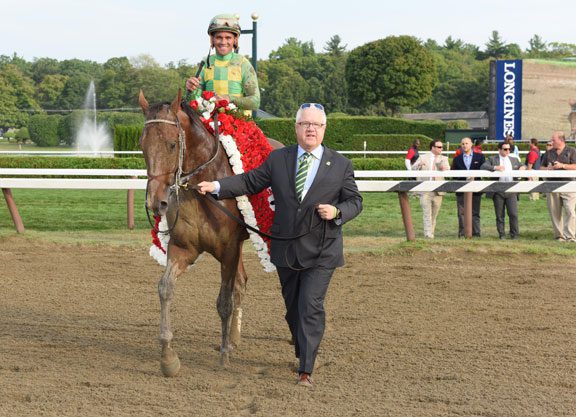
Donegal Racing’s Jerry Crawford, who admitted Wednesday that he is still decompressing from Keen Ice (Curlin)’s stunning victory over American Pharoah (Pioneerof the Nile) in the Aug. 29 GI Travers S., is busy strategizing for his assault on this year’s Keeneland September Yearling Sale. Crawford will be buying his eighth crop of yearlings for Donegal, the partnership group he founded in 2008, when the September sale launches next Monday.
Derby Dreams VIII was already popular before Keen Ice’s victory in the Midsummer Derby.
“Before the Travers, we had more than double the subscriptions for partnerships than we could fulfill,” Crawford confirmed. “That was before the Travers. Now I’m having trouble even answering all the e-mails and the telephone calls. I suspect we will end up with around 50 partners and we’ve had over 100 people already indicate that they would like to be partners.”
The popularity of the group is understandable given its level of success in a relatively short amount of time. Focused entirely on horses with Classic potential, Donegal has run in six Triple Crown races in its eight-year existence, finishing third in the GI Kentucky Derby with Paddy O’Prado (El Prado {Ire}) in 2010 and also with Dullahan (Even the Score) in 2012.
According to Crawford’s statistics, Donegal runners are averaging $36,581 per start in 2015. Three of seven sophomore colts this term have competed in graded stakes, and the crop’s lone filly, Puca (Big Brown), raced in the GI Kentucky Oaks.
Crawford attributes much of Donegal’s success to an algorithm he first developed to wager on Triple Crown races.
“It all started back in about 2000,” Crawford recalled. “I went with my same group of buddies every year to the Kentucky Derby and we had a grandstand box and we thought we had died and gone to heaven–except we kept losing when we bet the Kentucky Derby. So I started trying to figure out what do these horses who hit the board in Triple Crown races have in common. I started collecting data. In 2005 it started working. I couldn’t tell who would win the Kentucky Derby, but I could tell who wouldn’t win the Kentucky Derby or the Preakness or the Belmont. So instead of picking one of 20 horses to win, we were picking one out of four or five.”
After initial success at the betting windows, Crawford decided to try his theory out in the auction ring.
“In 2008, I thought, I am going to go to Kentucky, I’m going to buy a horse that fits my formula and see what happens,” Crawford explained. “I’d bought horses before. I wasn’t a stranger to the business, but it was the first time I tried to use the algorithm that we’d created to buy a horse. And in September of 2008, the stock market collapsed and the first thing people stopped doing was buying horses. So, having been prepared to spend $250,000 to buy one horse, I spent $410,000 on eight. Then I was flying home trying to figure out how I was going to avoid paying alimony after I told my wife Linda that I’d bought eight horses. My buddies had always said, ‘Go buy horses and we’ll be partners.’ And that’s how Donegal racing got started–that year that I bought eight horses not quite by accident.”
Likening his pedigree algorithm to baseball’s analytical crunch Moneyball, Crawford uses his approach to pinpoint very specific characteristics.
“If you call your partnership Derby Dreams, it means that you’re running in Classic distances,” he said. “Which means you have to have a creative approach to finding stamina. Certain sires have a propensity to produce stamina with certain broodmare lines, but not with others. So a sire might be highly desired by us with one broodmare line and of zero interest to us with another. Even though both broodmare sires are highly regarded. So that’s where we try to find the distinctions.”
Crawford’s data is telling him the traditional Classic pedigree might be changing. After years of graded stakes earnings providing berths into the GI Kentucky Derby, Churchill Downs changed to a points-based system three years ago. The change may have affected the outcome of the race in the last two seasons, according to Crawford.
“Historically, entry into the Kentucky Derby was based on graded stakes earnings and 2-year-olds would accumulate considerable graded stakes earnings in short-distance races that they were successful in,” Crawford said. “Now, the point system that Churchill initiated is very back loaded towards two-turn races for 3-year-olds. So those speedy 2-year-olds are no longer going into the gate. Which means that, for horses running on the front end–like a California Chrome or an American Pharoah–the pace isn’t as contested. The pace isn’t as fast. Any good horse can gallop along for a mile and then sprint home in a quarter of a mile. That’s what we’ve seen in the last two years. So we are really trying hard as we speak to figure out, does this indicate a permanent shift. We’ve got 32 years of data and, as the mathematicians say, we’ve got an n of 30 that shows us that stamina is the dominant theme, but now we have an n of two that tells us speed is the dominant theme. So we’re trying to get that all sorted out and it’s not easy.”
Donegal does most of its buying at Keeneland’s September sale. Paddy o’Prado was a $105,000 purchase in 2008, while Dullahan cost $250,000 at the 2010 renewal of the auction. Travers winner Keen Ice was acquired for $120,000 in 2013.
Crawford and his son Conor, a graduate of the Darley Flying Start program who was named Donegal’s vice president last summer, have been doing plenty of homework ahead of this year’s September sale.
“Once the catalogue is on-line, we start because it takes us so long to do what we do,” Crawford commented. “We literally put every single hip through our formula to determine who will make the long list. And then once we have a long list, I do my second cut and eliminate horses from it. And then we start the physical inspection of the horses once we get to the sale and the vet work and cardio work and all the things that many other people do. We will, in the first six or seven days of the sale, look at about 40 colts a day. And then starting in days four, five and six, we’ll look at a few fillies, too.”
Donegal has traditionally purchased between six and eight yearlings a year. That number might increase this year.
“We might go a little higher this year,” Crawford said. “But when I say a little higher, I’m talking about 10, not 15 or 20. It’s hard, by the way. Last year I bought eight horses, seven colts and one filly. There was nothing else that I wanted, nothing else that qualified on our system in our price range. We won’t spend $1 million on a horse–I think we averaged about $230,000 last year.”
In addition to his algorithm, Crawford is quick to give credit for Donegal’s success to his entire team of professionals, which includes Conor Foley and Jim Hatchett from Oracle Bloodstock, Byron Rogers from Performance Genetics, Sid Fernando from Werk Thoroughbred Consultants and veterinarian John Garrity. Trainer Dale Romans, who conditions Keen Ice, looks at the yearlings on Crawford’s short list, “and gives his opinion on athleticism.”
Crawford also singles out Frank Smith, who owns and operates Elloree Training Center in South Carolina.
“We send all of our yearlings to him to break and train,” Crawford said. “Everybody on our team is phenomenal, but he gets a star next to his name because I don’t think our horses would do as well as they do without the care and the teaching that they get from him and his team.”
Donegal also uses the services of several trainers across the country. In addition to Romans, the group has horses with Todd Pletcher, Bill Mott, Christophe Clement, Peter Miller and Tom Morley.
“We have partners in every corner of the country now and they love to have horses that race close to them,” Crawford said of his stable of trainers. “That by definition requires different trainers. I have also found I learn a lot when I work with different trainers. Different trainers have different approaches and I’m trying to know and learn as much as I can. Working with different trainers is very educational. And the last thing is, we like most everyone in the sport, have been the victim of sickness at one time or another. And you sure don’t want all of your horses in one barn if somebody gets sick.”
Unlike most racing partnership groups, Donegal offers one investment package a year, with every partner part owner of each horse in the crop.
“We don’t go to market with individual horses,” Crawford said. “If you join Donegal, you own a percentage of every single horse that we buy that year.”
Of the advantages of this structure, Crawford explained, “By having just one partnership per year with every partner owning a piece of every horse no partner ever misses out on ‘the big horse.’ For example, if we had sold our eight horses in Derby Dream VI individually all the folks who invested in the other seven horses would have missed out on owning Keen Ice. The way we do it, every partner for that year owns a piece of Keen Ice. It is what makes us different.”
The partnership group has exposed several new owners to the sport.
“The vast majority of our partners were new to racing when they came to Donegal,” Crawford said. “We will have over 200 people at the Breeders’ Cup, just for example. We will have 15 or 20 filter in and out for a couple of days at the sale. We have a huge group that turns out down in South Carolina for the spring unveiling of the 2-year-olds. So they are learning about the business.”
“They come from all walks of life,” he added of his owners, before adding with a chuckle, “although we do seem to be particularly heavy on orthopedic surgeons.”