

Jameka Wears the ‘Crown’ in Oaks
Updated: November 5, 2015 at 2:24 pm
by John Berry
Rick Jamieson of Gilgai Farm in Victoria will always be remembered as the breeder of Black Caviar (Aus) (Bel Esprit {Aus}). That outstanding sprinter, though, is not his only credit, his other proteges including her top-class half-brother All Too Hard (Aus) (Casino Prince {Aus}).
As he is accustomed to breeding good horses, it is possible that when Jamieson sold a Myboycharlie (Ire) filly from his mare Mine Game (Aus) (General Nediym {Aus}) at Melbourne’s Premier Yearling Sale in March 2014 for A$130,000 to successful Victorian trainer Ciaron Maher, he might have envisaged the filly playing a starring role at a future VRC Carnival at Flemington. If he did, one might presume that he might have been thinking that she could feature in one of the sprints, bearing in mind that her sire and both her grandsires–Danetime (Ire) and General Nediym (Aus)–had been high-class sprinters, and that her dam had recorded her only victory over 1400 meters.
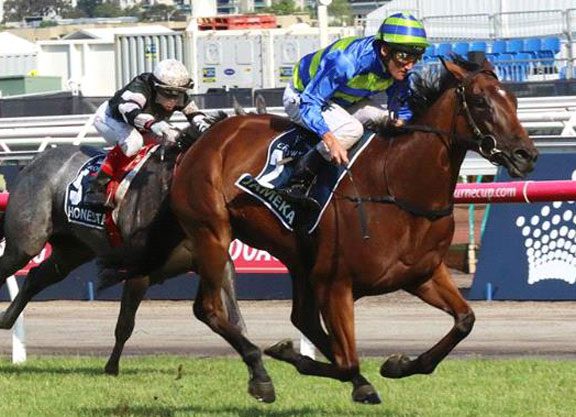
This filly, now named Jameka (Aus), has indeed found stardom at the Carnival at Flemington as a 3-year-old, but not as a sprinter. Many Victoria Oaks winners are fast, classy fillies who somehow stretch their speed out far enough to maintain their dominance over more dour rivals over the searching 2500-meter course. Not Jameka, though: her Victoria Oaks victory was all about stamina as she beat off the challengers to hit the line strongly in the style of a top-class stayer.
At first glance, Jameka’s powers of endurance might appear to have sprung out of nowhere. If we dig a bit deeper, though, they are easy to understand, because she comes from a family rich with high-class stamina.
Jameka’s third dam Pathos (The Minstrel) arrived in New Zealand in the late 1980s. At that time, New Zealand still stood proud as a source of high-class stayers. Pathos, a winner over 10 furlongs in England in 1987 when trained by Barry Hills, was a perfect addition to that country’s herd. She was by the 1977 G1 Derby and G1 Irish Derby winner The Minstrel from Warfever (Fr), a Grade I-winning daughter of the top-class French horse Luthier (Fr). Furthermore, this was a family which was serving Warfever’s owner Daniel Wildenstein particularly well, providing him with some of his best middle-distance horses including Warfever’s half-sister Waya (Fr), a daughter of the top-class miler Faraway Son who won the G3 Prix de Royaumont at Chantilly and G2 Prix de l’Opera at Longchamp in 1977 before becoming Eclipse Champion Older Female in America in 1979. Another half-sister to do well for the Wildensteins was the listed winner Warsaw (Fr), a daughter of the 1966 G1 Prix de l’Arc de Triomphe winner Bon Mot III (Fr).
During Pathos’ short breeding career (she only had three foals, all of whom won) she visited some of the best stallions in New Zealand. The pick of her offspring was the Sackford (USA) gelding Arigna (NZ), winner of 12 races in New Zealand at distances up to 2300 meters including the G3 Rotorua Cup. To the top-class Sir Tristram stallion Grosvenor (NZ) she bred Jameka’s second dam Aperto (NZ) who was also a good stayer, winning three races up to 2200 meters. Aperto raced in Melbourne, and then stayed in Australia for her breeding career.
It was only once Aperto was at stud in Australia that this branch of the family began to re-invent itself as a source of shorter-distance runners. She visited a series of sprinting stallions, most notably breeding the G1 Canterbury Guineas winner Jymcarew to the 1994 G1 Golden Slipper winner Danzero (Aus), the star of the first Australian crop of Danehill. In 2004 she visited the top-class sprinter General Nediym–who is related to some top-class stayers including 1989 Japan Cup heroine Horlicks (NZ) and her G1 Melbourne Cup-winning son Brew (NZ)–and thus bred Jameka’s dam Mine Game.
Mine Game, a winner in Melbourne over 1400 meters, was thus merely what one might call a first-generation sprinter, and it is easy to see why she could impart stamina into her offspring. In fact, it is particularly easy to see why she could do it when mated with Danehill-line stallions, notwithstanding the fact that Danehill himself was a sprinter who sired many very fast horses.
Of the members of this family who remained in the hands of the Wildenstein family, the one who ultimately provided her owners with the most glory was Walensee (GB), a daughter of the 1979 G1 Derby and G1 Irish Derby winner Troy (Ire). Firstly, Walensee, a daughter of the aforementioned Warsaw, carried the Wildenstein colours to victory in three races in 1985 including the G1 Prix Vermeille over 2400 meters. Then she did even better at stud, breeding a true champion. Her mating with Danehill in 1998 reminded us that Danehill was an influence for class right across the distance spectrum, rather than merely an influence for speed. A staying mare could breed a high-class stayer to Danehill, and few stayers have ever been better than Walensee’s Danehill colt Westerner (GB), who twice completed the double of G1 Prix du Cadran /G1 Prix Royal-Oak, in addition to landing the G1 Ascot Gold Cup (in 2005).
So it has turned out with Westerner’s relative Mine Game. Her mating with Danehill’s G1 Prix Morny-winning grandson Myboycharlie has yielded Jameka, a filly with enough speed to win the G2 VRC Sires’ Produce S. over 1400 meters at two, but with enough stamina to relish the 2500 meters of the G1 Victoria Oaks as a 3-year-old.