

Khan A Boost To Antipodean Breeding
By John Berry
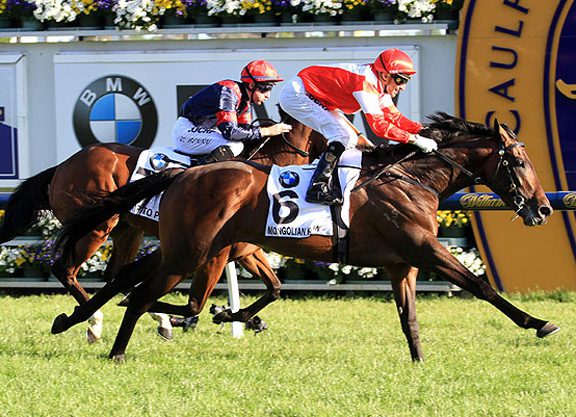
With so many imports playing starring roles in Australia’s feature races over middle and long distances, the bloodstock industries in both Australia and New Zealand have been needing a boost. The win of the Holy Roman Emperor (Ire) (Danehill) 4-year-old Mongolian Khan (Aus) in the G1 Caulfield Cup is thus very welcome because it provides a source of pride for horsemen on both sides of the Tasman Sea. New Zealand in particular used to be a very fertile source of champions at 2000m and beyond. However, the likes of Dundeel (NZ) (High Chaparral {Ire}) – the winner of six Group 1 races between 1800m and 2400m in Australia, where he raced as It’s A Dundeel – are few and far between nowadays. Furthermore, Dundeel is now in his second season covering mares at Arrowfield Stud in New South Wales, and his retirement after the 2014 Sydney Autumn Carnival left a notable gap in the colonial-bred staying ranks. Happily, Mongolian Khan (who is trained by Dundeel’s former handler Murray Baker) seems capable of filling that gap, judged on the solid manner in which he added the Caulfield Cup to his victories last season in both the New Zealand Derby and the Australian Derby.
Remarkably, Mongolian Khan’s success acts as a boost not only to the bloodstock scenes in both Australia and New Zealand, but to those in no fewer than three individual states in the former country.
Conceived at Coolmore Stud in New South Wales, Mongolian Khan was bred in Tasmania at Graeme McCulloch’s Grenville Stud. He was then sold for A$9,000 as a weanling in Victoria at Inglis’ Great Southern Weanling Sale in Melbourne in May 2012, bought outright by McCulloch who had bred him under a foal-sharing deal.
McCulloch then offered him as a yearling in New Zealand, in the Ainsley Downs Stud draft at the New Zealand Bloodstock Select Yearling Sale in January 2013. Having been bought there by Waikato Bloodstock for NZ$140,000, he reappeared in the same auction ring 10 months later. On that occasion he topped the NZB Ready-To-Run Sale at NZ$220,000, bought by Graeme Forbes on behalf of Mongolian Rider Horse Industry (NZ) Ltd, the extensive bloodstock enterprise headed by Lang Lin from Manchuria. And the rest is history.
So strong is New Zealand’s breeding industry and so under-funded its racing set-up that equine traffic across the Tasman Sea tends mostly to be Australia-bound. However, Mongolian Khan’s victory in last season’s G1 NZ Derby made him the third Aus-bred to take that race in the past decade, following the Australian-trained pair Redoute’s Dancer (Aus) (Redoute’s Choice {Aus}) and Coniston Bluebird (Aus) (Scenic {Ire}), who took the race in 2007 and 2009 respectively. He is, though, the first Tasmanian-bred horse to take the race – which is hardly surprising, bearing in mind that Tasmanian-bred Group 1 winners even on mainland Australia are rare. Prior to Mongolian Khan’s Australian Derby victory last April, it had been 19 years since the last Tasmanian-bred Group 1 triumph in Australia, when Alfa (Aus), a son of El Moxie (Conquistador Cielo), had landed the 1996 G1 Caulfield Guineas. Six years before that the Tasmanian-bred gelding Sydeston (Aus), a son of St Briavels (GB), had won the G1 Caulfield Cup.
Fittingly for a horse who is bringing pride to both Australia and New Zealand, Mongolian Khan is a son of Centafit (NZ) (Centaine {Aus}) who ranks as probably the only broodmare in history to have produced two individual Australian-bred sons who have their names on great rolls of honor in New Zealand; her Jeune (GB) (Kalaglow {GB}) gelding Young Centaur (Aus) won the G1 Wellington Cup in 2008. Furthermore, Centafit is a daughter of another horse who brought glory to the breeding industries of both countries; Centaine. The champion sires Better Boy (Ire) and his brilliantly fast son Century (Aus) rank as perhaps the two greatest stallions to have stood in Victoria in the modern era. Century bred many champions, but Centaine wasn’t one of them – which was just as well for New Zealand, because it meant that, having landed his only Pattern race in Group 3 company, he was not snapped up by any of Australia’s leading studs. Instead, he headed to New Zealand to stand under the auspices of Garry Chittick at Thornton Park Stud near Palmerston North (and later at Chittick’s subsequent property, Waikato Stud near Matamata). Centaine came from a great Australian family. His fourth dam Rainbird (Aus) won the Melbourne Cup in 1945, while his dam Rainbeam (Aus), a daughter of the great sprinter Vain (Aus) won the Silver Slipper Stakes at Rosehill in 1975. The family has been represented in recent years by the high-class sprinter Rain Affair (Aus) (Commands {Aus}) while Centaine, who sired several top-class horses including Slight Chance (NZ) and Kinjite (NZ), continues posthumously to do his bit as an excellent broodmare sire. It is thus fitting that Centaine should feature prominently in the background of Mongolian Khan, a terrific stayer who is providing a good fillip to horsemen on both sides of the Tasman Sea.