

Look Forward, Not Back, to Define Pharoah’s Legacy
By T. D. Thornton
In the 37-year gap between Triple Crown winners, something shifted in the sport’s narrative. The longer racing went without an identifiable, iconic champion who captured the hearts and riveted the attention of a nation, the deeper the yearning got for a horse of a generation to come along and hit the magic “reset button” that would re-establish the game not merely as the “Sport of Kings,” but as the king of sports.
At times, that narrative seemed a bit forced, even desperate. If you work hands-on with Thoroughbreds or ply your trade in any other aspect of the racing industry, you realize that the notion that a single horse can “save the sport” is not grounded in reality. It’s also folly to keep wishing for a return to the “glory days,” because even though our sport is deeply rooted in tradition, a constant yearning for the way things used to be does nothing but inhibit growth and obstruct racing’s progress.
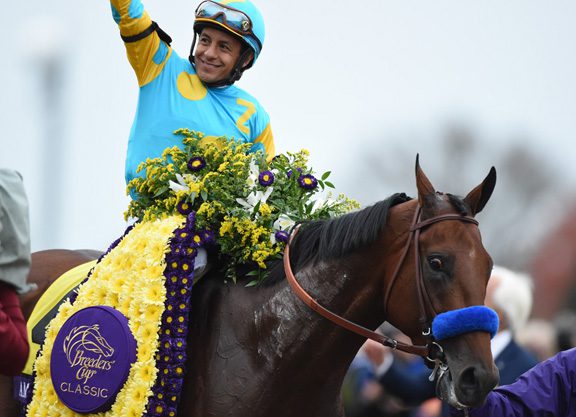
Earlier this year, racing got its long-awaited, larger-than-life gift horse in the form of a Triple Crown champion. In Saturday’s GI Breeders’ Cup Classic, American Pharoah (Pioneerof the Nile) outsprinted a solid group of older rivals straight from the gate and never looked back en route to a 6 1/2-length victory and a permanent spot among the game’s all-time greats.
There were many feel-good moments along the way, and the storybook ending for American Pharoah’s final race came off largely as anticipated, with the sun setting on Keeneland Race Course while emotional jockey Victor Espinoza patiently paraded the people’s horse before an adoring crowd.
“This is all for American Pharoah. We are so indebted,” said Ahmed Zayat, the colt’s principal owner, who races as Zayat Stables, LLC. “We owe him the whole world. America, my family and everybody–what a horse.”
Now it’s up to the sport’s stakeholders to keep the momentum going.
Instead of looking back, racing’s long-term health will benefit if American Pharoah’s legacy is viewed in terms of what his remarkable run of 2015 will do for the game going forward, and how it might shape the sport for years to come.
For starters, remember the fear in recent years that accompanied the prospect of other horses on the verge of winning the Triple Crown–that the economics of the industry would force a Triple Crown winner’s immediate retirement to the breeding shed? That didn’t happen with American Pharoah, largely because Team Zayat felt a deep obligation to the public to keep the star colt in training.
And trainer Bob Baffert, on a daily basis, went out of his way to make sure that the pride of his stable was as accessible to fans as practically possible, further strengthening the bonds between the public and the champ.
All of this Pharoah-related good will was captured and repeated exponentially throughout the year via social media, which marks another remarkable shift in how racing has embraced fan outreach and new ways to market the game. You hear the oft-repeated lament that traditional media coverage is dying. But in reality, it’s just changing. And racing, at least in this respect, seems ahead of the curve compared to other sports.
The most notable change brought about by American Pharoah’s scintillating win Saturday might be the introduction of the brand new phrase that was coined to sum up his on-track brilliance: he became the sport’s first-ever “Grand Slam” winner, as the opportunity to win the Breeders’ Cup Classic did not exist for any of the previous champions who swept the GI Kentucky Derby, GI Preakness S. and GI Belmont S. prior to 1984.
And hours before American Pharoah earned that distinction, Saturday’s pair of Breeders’ Cup races for 2-year-olds opened the tantalizing possibility that the sport might be in for another wild ride toward a potential Grand Slam champ next year: GI Sentient Jet Breeders’ Cup Juvenile winner Nyquist (Uncle Mo) and GI 14 Hands Winery Breeders’ Cup Juvenile Fillies victress Songbird (Medaglia d’Oro) are both undefeated heading into 2016. @thorntontd