
Immediate Decoupling Scare Over, But Still a Long-Term Threat in Florida
Updated: March 3, 2016 at 3:51 pm
By T. D. Thornton
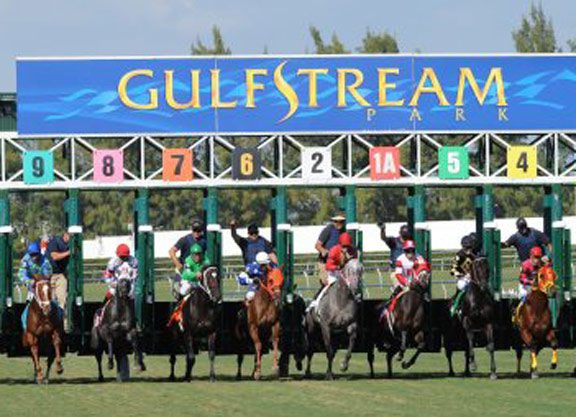
With the 2016 Florida legislative calendar fast closing in on its Mar. 11 end date and no agreement in sight on massive, sweeping gambling bills in both the House and Senate, the finger-pointing about nothing being done on the most controversial issue of the session is already starting.
“Gaming bills tend to die of their own weight,” Senate President Andy Gardiner bluntly told the Miami Herald earlier this week. Senator Tom Lee used a more vivid metaphor in the Tampa Bay Times: “Every time you put a gaming bill up in the Florida Legislature, it's like throwing a side of beef into a shark tank.”
So presuming there are no surprise gambling-related votes over the next week in either the House or the Senate, where does the impasse on the bills leave Florida's Thoroughbred horsemen and breeders, who have for months been fighting an uphill battle against the inclusion of decoupling in the multi-faceted pieces of legislation that have been up for debate?
Decoupling–which is essentially a clause to allow Florida's pari-mutuel licensees to drop live racing while still remaining open as casinos–has occupied only a small slice in a much broader negotiation known as the 20-year, $3 billion Seminole Gaming Compact. Decoupling is of paramount importance to Thoroughbred interests because it would almost certainly lead to a long-term loss of racing dates. But the topic came up only peripherally during legislative hearings, which were largely dominated by the issues of revenues, taxation, and licensure related to other forms of betting.
“The compact as presented probably represented the most complicated, complex, tribal compact in the history of the United States,” Lonny Powell, the chief executive officer of the Florida Thoroughbred Breeders' & Owners' Association, said in a Thursday phone interview. “And it also represented, according to elected officials during the hearings, the largest potential economic contribution from a tribe to a state. So that made this whole issue huge, but heavy.
“But there are still a lot of people, for a lot of reasons, who don't want to see it die or don't want to leave it up to the courts to decide, or a special session, et cetera,” Powell continued. “And that's why you always have to watch and wait for the whole thing to play out to the very end. We're not doing any high-fiving, victory dancing, or ball-spiking right now until the session is over. ”
Florida Horsemen's Benevolent and Protective Association president Bill White agreed on Thursday that there was only a “very, very small likelihood” that Florida's two legislative bodies would pass an agreed-upon bill within the next week.
White said it's possible that House might vote on a version of its gaming bill because it has already passed the House's finance and tax committees, but without a companion bill in the Senate, “it would just be the House showing that they're for it [and] kind of putting the spotlight on the Senate for not taking action.”
In most years, regular 60-day sessions of the Florida Legislature begin in March. But this year's session started in January so as not to get in the way of the Mar. 15 presidential primary election. A 20-day special session could still be called later in the year to decide the outcome of the compact, but both White and Powell said that was unlikely considering there is ongoing gaming litigation in the state's courts and the general election scheduled for November.
“We're cautiously optimistic that the status quo remains,” Powell said. “But we'll leave a footnote, all the way through the process, that live Thoroughbred racing was protected. So we never faced the 'nuclear option' of Thoroughbred decoupling, but the other breeds were definitely in the process of being decoupled, and that's not a good precedent.”
White said decoupling is important enough that it should be decided on its own and not tacked on as “afterthought” to something like the Seminole compact. But he conceded that the prospect of the state revisiting decoupling individually in the future is “not likely” because Florida tends to deal with gambling issues “comprehensively and not piecemeal” in its Legislature.
“Eventually, it will come back,” White said. “This isn't going to go away. There is a tremendous amount of energy in the state of Florida to decouple the dogs. And the reason the horses are brought into it is that we're also a par-mutuel licensee, so the controversy comes up how can you decouple the dogs and not the horses? They're both considered equal licensees in the eyes of the state of Florida.”
Powell sees the situation similarly: “The greyhound tracks are committed to getting out of the racing business, so I think they'll keep the drums beating on the issue, as will a couple horse tracks like Hialeah and Calder. We're better for [no legislation passing]. We're drained. But at the same time, there's no way that the work is over. My team and I are already looking at the mid- and long-term opportunities where we can grow the business. We shift right back into that–you protect the business, but you also want to grow it.”
Both White and Powell urged Thoroughbred horsemen around the country to be actively preparing for decoupling threats in other states where gaming revenues are linked to live racing.
“Beyond Florida, the industry really needs to pay attention to this,” Powell said.
Powell explained that larger racing states, like Florida, Kentucky, California and New York, have “more tools in our arsenals to make a case. But that's not the rest of the country. The rest of the country is made up of a lot of hard-working, blue-collar racing jurisdictions [with] tracks that struggle, or tracks that are dominated by the racino end of the operation, or they're in a highly competitive [gaming] environment, or in a state where the Thoroughbred industry isn't the dominant breed.”
One very specific suggestion Powell had for other horsemen's organizations was to make sure they invest in having up-to-date economic impact studies ready to supply to lawmakers. If you wait until any sort of decoupling debate starts, and then try to make your case with outdated metrics that don't accurately portray how the Thoroughbred industry contributes to the state's economy, you're operating from a position of weakness, he said.
“My advice to the horsemen of the country is to have ongoing dialogues with your local racetracks, and make sure they're committed to live racing,” Powell said. “And if they're anything short of that, or wanting to keep their options open, you need to start coming up with a Plan B and a Plan C and a Plan D of how you're going to deal with it.”